Our website is using cookies to deliver best possible experience to you. By using it you agree to cookies policy.


The European Commission has published its latest ‘State of the Digital Decade’ report, summarising the year 2026. How is digital Europe developing, and where does Poland stand in this race? On the one hand, we can boast excellent e-services and rapid expansion of fibre-optic networks, but on the other, our business sector remains cautious about artificial intelligence, and key infrastructure investments are at risk of losing funding in the near future. Read our summary to find out what challenges the Polish and European economies are facing.
The European Commission has just published the ‘State of the Digital Decade 2026’ report. The report summarises the state of digitalisation in Europe, allowing us to assess how Poland compares in this context. We face many challenges ahead, and key support programmes are due to expire shortly.
Progress and challenges on the Old Continent
Europe is undoubtedly making progress. The report shows that 96.8 per cent of EU households are within 5G coverage. European companies are increasingly embracing advanced technologies. The use of artificial intelligence is set to rise by 48 per cent by 2025, although the lack of specialists and adequate infrastructure remains a barrier for small and medium-sized enterprises.
However, technological sovereignty remains a weak point for Europe. The EU’s share of the global semiconductor market stands at just nine per cent, whilst the target for the end of the decade is 20 per cent. Staff shortages also pose a huge challenge. ICT specialists account for only five per cent of the total workforce, of whom women make up less than 20 per cent. The European Commission is also sounding the alarm on the issue of funding. Every euro invested from the Recovery and Resilience Facility yields a return of 1.5 euros for the economy, but almost half of the funds from national roadmaps will expire at the end of 2026.
Furthermore, according to a 2026 Eurobarometer survey commissioned by the European Commission, 82 per cent of Europeans are in favour of reducing dependence on non-EU suppliers. This view is shared by 80 per cent of Poles. Meanwhile, 79 per cent of respondents consider the development of digitalisation to be a key priority for the European Union as a whole, and 85 per cent support investment in European digital solutions. Furthermore, 58 per cent of citizens express a willingness to use European technologies, even if they are slightly more expensive. A similar view is held by 64 per cent of Poles. This is also consistent with the findings of our report “Technological Sovereignty of Poland and Europe. Public Opinion Survey Report. 2026 Edition.”
The Digital State and Business in Poland
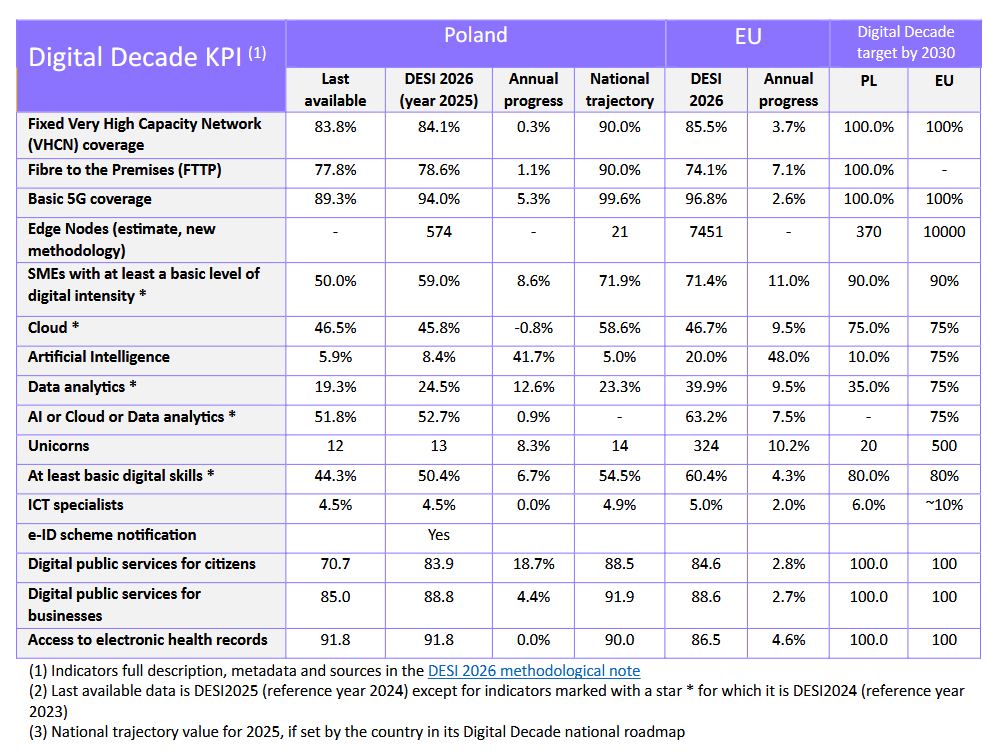
How is Poland faring in this digital race? We have our strengths, particularly in the area of public services. With 91.8 per cent of the population having access to electronic medical records, we are ahead of the EU average of 86.5 per cent. The roll-out of the fibre-optic network (FTTP) is also performing relatively well, already reaching 78.6 per cent of users. Our public digital services for citizens and businesses are on a par with the rest of Europe.
Unfortunately, Polish businesses lag significantly behind in terms of digitalisation. Only 8.4 per cent of our companies use artificial intelligence, whilst the EU average stands at 20 per cent. We have a considerable gap to close in the use of cloud computing (45.8 per cent) and data analytics, which are utilised by just 24.5 per cent of Polish enterprises. Only 50.4 per cent of the Polish population possesses basic digital skills, and the proportion of ICT specialists has stagnated at 4.5 per cent, whilst the EU target is to reach 10 per cent.
Key funding in doubt
Poland has planned 55 digital initiatives with a budget of €12.4 billion, but as many as 40 per cent of these initiatives will lose their funding by the end of 2026. This corresponds to €3.69 billion in public funds, or 30 per cent of the total amount allocated for this purpose from the state budget. This is extremely significant, particularly as, according to the OECD, the scale of investment in the ICT sector in Poland, measured as a share of GDP, is falling (from 0.98 to 0.95). This situation will significantly hinder the achievement of the objective of increasing expenditure on digitalisation.
You can read the full report on the official EU websites.