Our website is using cookies to deliver best possible experience to you. By using it you agree to cookies policy.


The latest research shows that as many as 77 per cent of Poles have encountered digital disinformation, and 79 per cent believe that its scale on the internet has increased over the last five years. During the official launch of the report, leading experts, chaired by Dr Michał Boni, discussed how disinformation and influence operations undermine national security, democratic processes and trust in public institutions. The panellists were in agreement — effective defence requires firm, immediate action and shared responsibility on the part of the government, the tech sector, the media and fact-checking organisations.
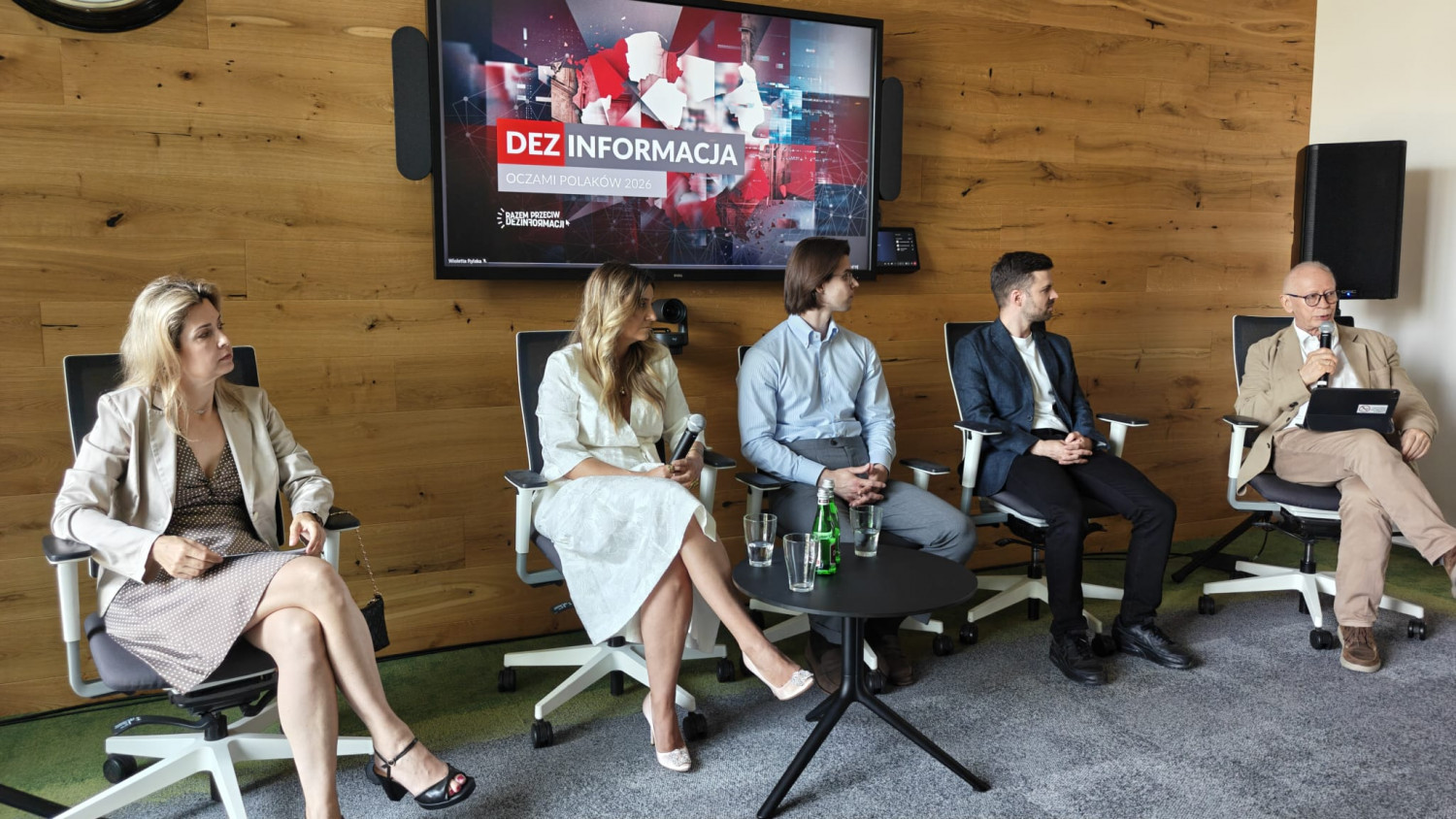
The launch of the third edition of the report on the state of disinformation in Poland, along with the accompanying discussion with experts, has now taken place. The study clearly shows that Poles have encountered disinformation on a massive scale; they perceive it as a serious problem and a tool of influence aimed at the foundations of the state – security, democratic processes, trust in institutions and social relations. Poles expect decisive action from technology platforms, the state, the media and fact-checkers.
What did the experts discuss during the launch?
The debate was chaired by Dr Michał Boni, the Foundation’s president. The discussion featured specialists who assessed the systemic threats to our infosphere from various perspectives:
Dr Agnieszka Jankowska (Director of T-Mobile Polska / Chair of the Council for Digitalisation) – outlined the threats to the functioning of the state, the effectiveness of current systemic measures, and the role of the technology sector and anti-disinformation policies in the private sector. She highlighted initiatives such as educational campaigns carried out by the telecommunications sector.
Maia Mazurkiewicz (Chair of the PZU Foundation) – spoke about Poles’ online fears in relation to age, gender and education, the risks to electoral processes, and how civil society organisations can work together effectively in this fight. She mentioned a range of initiatives undertaken by the PZU Foundation – such as the #czystyprzekaz campaign.
Adam Maternik (a specialist at NASK – the National Research Institute) – presented the findings of an analysis of the main media channels and alternative sources of information in Poland, and discussed the institutional defence tools being implemented by NASK.
Patryk Zakrzewski (Vice-President of the Demagog Association) – broke down the cultural and political reasons behind Poles’ high susceptibility to conspiracy theories and highlighted the real impact of fact-checking activities on us, as well as how to strengthen this network.
The experts assessed the level of threat posed by disinformation fuelled by algorithms and generative AI, and formulated key recommendations for improving the country’s information resilience. The conclusion is clear: we need close cooperation between the state, technology platforms, the media, the business sector and civil society organisations.
We would like to extend our sincere thanks to the report’s partners, without whom this project would not have been possible: the PZU Foundation, T-Mobile Polska, Konkret24, NASK – the National Research Institute, Ringier Axel Springer Polska, the Demagog Association, TVN Warner Bros. Discovery and the University of Warsaw.
We carried out this project as part of the ‘Together Against Disinformation’ coalition.