Our website is using cookies to deliver best possible experience to you. By using it you agree to cookies policy.


During this year’s IGF Polska 2026 in Bydgoszcz, we discussed one of the greatest challenges facing modern society: the impact of disinformation on public trust. The debate was attended by representatives of civil society organisations, the academic community, public administration and institutions dealing with information security. The conclusions do not inspire optimism, but at the same time they point to courses of action that could reverse these negative trends.
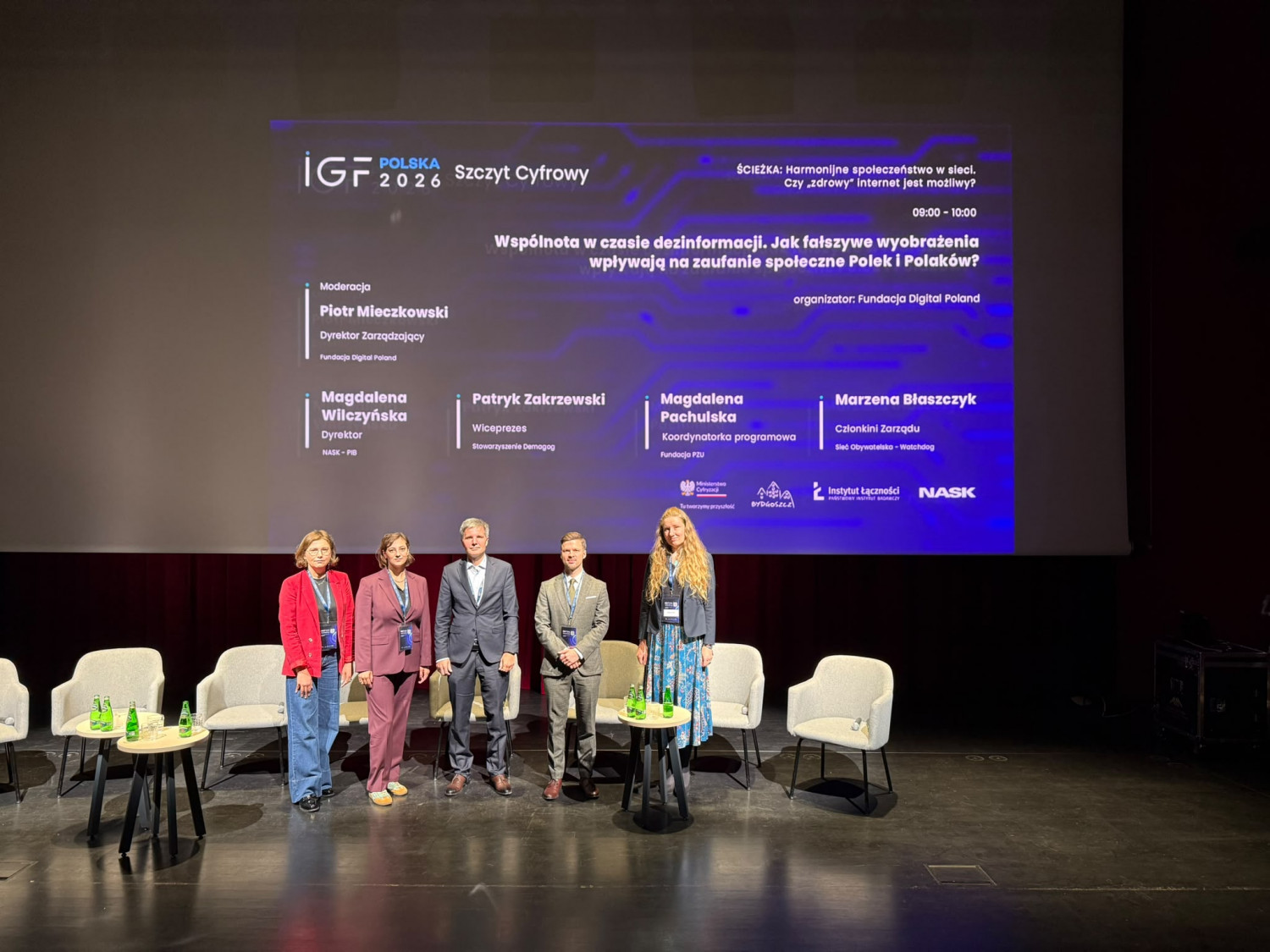
The discussion took as its starting point the findings of the latest report by the ‘Together Against Disinformation’ Coalition, prepared by the Digital Poland Foundation in collaboration with its partners: NASK, T-Mobile Polska, the PZU Foundation, SWPS University, Demagog, Ringier Axel Springer Polska and TVN Warner Bros. Discovery.
The key conclusion is simple: disinformation is no longer a marginal phenomenon. It has become a permanent feature of our infosphere, influencing the way Poles perceive reality, public institutions and one another. It is particularly worrying that false and manipulative content most often exploits emotions – primarily fear and anger – whilst the mechanisms by which social media platforms operate further exacerbate social polarisation.
Patryk Zakrzewski from the Demagog Association spoke about the findings of research concerning young people, also referring to analyses carried out by Konrad Ciesiołkiewicz.
The debate highlighted the problem of increasing social fragmentation and declining trust in sources of information. Young people are increasingly operating within distinct information bubbles, which hinders dialogue and the formation of a shared understanding of reality. Without rebuilding public trust, effectively combating disinformation will be extremely difficult.
Marzena Błaszczyk from the Watchdog Polska Citizens’ Network drew attention to another important aspect of building trust: transparency in public life.
During the discussion, the negative impact of SLAPP lawsuits on the media and civil society organisations was highlighted, as was the problem of certain local media outlets being used for propaganda purposes and the insufficient transparency of public institutions.
A particularly interesting example was the Central Register of Contracts (CRU). Although the obligation to publish information on contracts applies to tens of thousands of public bodies, the pace of implementing these new obligations remains a challenge. This shows that simply creating a tool is not enough. Effective mechanisms to encourage its use are equally important.
Magda Wilczyńska from NASK presented data illustrating the scale of the problem with content moderation by online platforms.
Although tens of thousands of potentially harmful items are reported to platforms, only a small proportion of them are effectively removed. Even more often, only partial moderation or restriction of the content’s visibility takes place. In practice, this means that harmful material can still achieve significant reach before it is properly flagged or removed.
This is yet another argument in favour of strengthening cooperation between the state, civil society and digital platforms.
Magda Pachulska from the PZU Foundation presented preliminary findings from a report on the social well-being of Poles, prepared in collaboration with the Dbam o Mój Zasięg Foundation.
The findings point to a growing sense of loneliness, a decline in trust in other people and deepening social atomisation. These are particularly dangerous phenomena, as it is precisely in an environment of low trust that disinformation spreads most easily.
The panellists agreed that Poland needs a better-coordinated system for countering disinformation and a faster response to emerging threats.
The ‘Together Against Disinformation’ Coalition has long been highlighting the need to establish sustainable mechanisms for cooperation between the administration, experts, civil society organisations, the media and the technology sector. We have particularly high hopes for the development of the Centre for Combating Disinformation’s activities.
To conclude the discussion, I raised the issue of automated accounts and bots used to spread disinformation.
One of the most promising avenues appears to be the development of solutions that allow users to anonymously confirm that a real person is on the other side. We have high hopes in this regard for the European Digital Identity Wallet (EUDI Wallet), which may in future enable the secure and private verification of users without the need to disclose their personal data.
At the same time, proposals to restrict the youngest users’ access to social media and to introduce additional protective measures for children and young people are being discussed with increasing seriousness.
Disinformation is not merely a technological problem. It is a societal challenge that affects the level of trust between people, the functioning of democracy and the resilience of the state.
That is why we simultaneously need more effective content moderation, greater transparency from public institutions, media literacy education, support for independent media, and new technological solutions to limit the influence of bots and manipulative campaigns.
We would like to thank the Ministry of Digital Affairs for creating a space for this important discussion during IGF Poland 2026. We hope that the recommendations put forward during the debate will translate into concrete actions to strengthen Poland’s information resilience.