Our website is using cookies to deliver best possible experience to you. By using it you agree to cookies policy.


Over 2.1 million participants, 34.2 million people reached by the information, more than 85 events and over 60 partners involved over the six weeks during which the educational activities took place. The 8th edition of the Digital Festival has come to an end; its theme was ‘You can do more with a digital identity’. At this year’s festival, the Digital Poland Foundation highlighted the key role of digital identity, which makes it easier for us to use digital services provided by the state or the private sector. At the same time, the findings of a report published during the festival show that Poles want technological development to go hand in hand with data protection, cybersecurity and the preservation of human control over the most important decisions in the country.
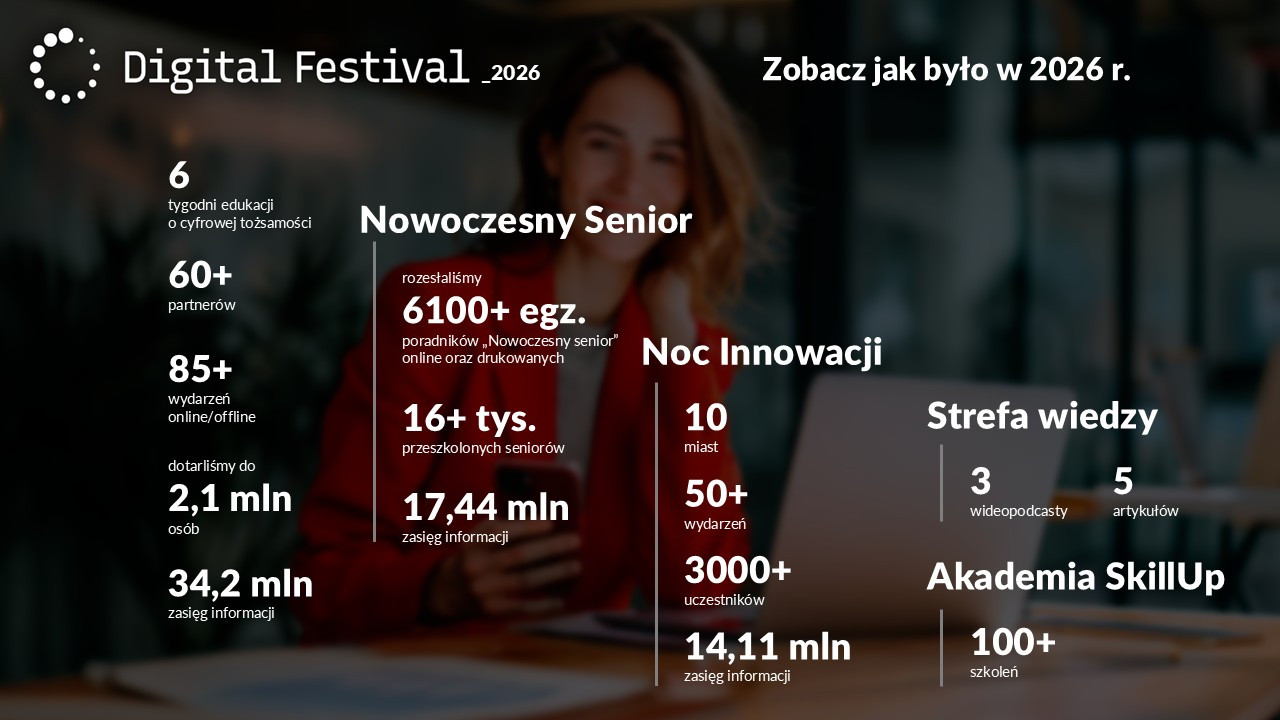
Over the course of six weeks, the Digital Festival introduced participants to topics relating to digital identity, artificial intelligence, cyber security, the digital state and the skills of the future. The festival featured over 85 online and in-person events, with more than 60 partners involved in the initiative. The educational activities reached a total of 2.1 million people, whilst the total reach of the information amounted to 34.2 million.
Digital identity at the heart of the festival
The theme of the 8th edition of the Digital Festival was digital identity. This year’s slogan, ‘You can do more with a digital identity’, highlighted the practical possibilities associated with verifying identity and authorisation, accessing e-services, signing documents and using digital solutions in Poland and other European Union countries. The theme was directly linked to the planned roll-out of the European Digital Identity Wallet, or EUDI.
“The eighth edition of the Digital Festival demonstrated that digital identity is not a theoretical concept but has become, for many of us, a practical tool used in everyday life. It can facilitate access to public, educational, healthcare and financial services and, importantly, from next year, also beyond Poland’s borders within the European Union. For citizens to genuinely want to use it, it must inspire trust, guarantee cybersecurity and ensure the user has full control over their data. Technology offers us ever more possibilities, but it is up to each of us to decide when, to whom and to what extent we confirm our identity” — says Dr Michał Boni, president of the Digital Poland Foundation, former Minister for Digital Affairs and Administration, assistant professor at SWPS University and a member of the EESC.
Innovation Night in 10 cities
One of the highlights of the festival was the 8th Innovation Night. A total of over 50 events took place across ten Polish cities, attended by more than 3,000 people. Coverage of the Night of Innovation reached 14.11 million people. Participants were able to take part in workshops, demonstrations and meetings with experts, as well as visit companies, universities, research institutes and organisations developing new technologies.
The programme of events covered, amongst other things, artificial intelligence, automation, cybersecurity, robotics, 3D printing, augmented reality, digital media and the use of data. The aim of the event is to showcase innovation from a practical perspective and open the door to the world of technology not only for specialists, but also for school pupils, university students, families, senior citizens and anyone interested in the changes taking place in the economy and society.
“In a world full of uncertainty, in the face of a rapidly changing geopolitical situation and the unprecedented pace of development in artificial intelligence, digital security is no longer merely a matter of good practice. It is becoming our shared responsibility” — says Grzegorz Pabian, Consulting Europe Cyber Security and Consulting Spain Leader at EY GDS, the Main Partner of Innovation Night.
Over 16,000 seniors trained
An important part of the Digital Festival was the latest edition of the ‘Modern Senior’ programme, including its Warsaw edition organised in collaboration with the city administration. As part of the initiative, over 16,000 senior citizens were trained, and over 6,100 copies of the ‘Modern Senior’ guidebooks were distributed in both electronic and printed formats. The programme reached 17.44 million people.
These activities addressed the need for the safe and informed use of digital services, particularly in the face of the growing scale of online fraud, attempts to phish for data, scams and content generated using artificial intelligence.
The educational programme was complemented by the Knowledge Zone, which published three video podcasts and five articles, and the SkillUp Academy, offering over 100 training courses to develop digital skills.
Poles are using digital public administration services en masse, but want to retain control over their data
The eighth edition of the report ‘Technology in the Service of Society. Will Poles Become a Society 5.0? 2026 Edition’, prepared by the Digital Poland Foundation in collaboration with Bank Gospodarstwa Krajowego and NielsenIQ, also premiered during the Digital Festival. The survey shows that digital public services have become mainstream, but the further development of the digital state depends on citizens’ trust. Over the past year, 83 per cent of Poles have used e-government services, and nearly 8 in 10 users rate the direction of its development positively. At the same time, 6 out of 10 respondents believe that digitalisation has simplified and sped up the process of dealing with official matters. The mObywatel app was used by 7 out of 10 Poles aged between 18 and 75.
“Poles no longer wonder whether the state should be digital, as it has become part of their everyday lives. Today, the key challenge is, above all, building trust in the digital state” — points out Anna Węgrzynowicz, an expert on social responsibility at Bank Gospodarstwa Krajowego.
Respondents are open to the use of artificial intelligence in public administration, but do not want to hand over full responsibility for decisions to it. 69 per cent of Poles prefer a model in which AI supports civil servants, analyses cases, prepares proposed decisions or identifies the relevant regulations, but the final decision remains in human hands. Only 9 per cent of respondents accept the full automation of administrative decisions.
The report also shows that Poles are not yet ready to move away from paper entirely. Nearly 5 in 10 respondents accept exclusively electronic contact with the administration, whilst 67 per cent fear that an administration based solely on digital documents could become paralysed in the event of a major failure or cyber-attack.
The report’s findings confirm the significant potential of the European Digital Identity Wallet. Three in four Poles say they would be willing to use the EUDI. The largest group, 36 per cent, would choose a wallet offered exclusively by the state, such as an enhanced version of the mObywatel app. A further 33 per cent would like to be able to choose between a public and a private solution. Only 7 per cent of respondents would choose a wallet offered exclusively by a global technology company. At the same time, 47 per cent of respondents would place the greatest trust in a Polish or European provider, whilst 7 per cent of Poles would trust solutions from big tech companies.
The practical applications of the digital wallet are generating the greatest interest: 37 per cent of respondents would like to use the EUDI for international financial services and payments, 35 per cent for medical services, and 33 per cent when dealing with official matters in other countries. More than half view positively the possibility of verifying individual attributes, such as being of legal age, without disclosing a full set of personal data.
Collaboration between over 60 partners
The Digital Festival was held under the honorary patronage of the Conference of Rectors of Polish Academic Universities, the Ministry of Digital Affairs, the Ministry of National Education, the Ministry of Science and Higher Education, the National Centre for Research and Development, and the Łukasiewicz Research Network. The event was also held under the patronage of, amongst others, the National Chamber of Electronic Economy and Telecommunications. The strategic partners of the 8th edition of the Digital Festival were Ringier Axel Springer Polska and TVN Warner Bros. Discovery. The festival’s partners were Bank Gospodarstwa Krajowego, EY and NielsenIQ.
The report “Technology in the service of society. Will Poles become a Society 5.0? 2026 Edition” can be downloaded free of charge after registering on the Digital Poland Foundation’s website.
About the Digital Festival
The Digital Festival is the largest private educational and technological initiative in Poland, organised annually by the Digital Poland Foundation. The festival provides educational materials on new technologies, digitalisation and artificial intelligence to people of all ages. The eighth edition took place from 1 October to 10 November 2026 under the slogan ‘You can do more with a digital identity’.