Our website is using cookies to deliver best possible experience to you. By using it you agree to cookies policy.

To mark the launch of the Digital Festival, the Digital Poland Foundation has published the eighth edition of its report, ‘Technology in the Service of Society: Will Poles Become a Society 5.0?’. This year’s survey shows that digital public administration has become part of everyday life for Poles. However, citizens want technological development to be accompanied by security, transparency and human responsibility.
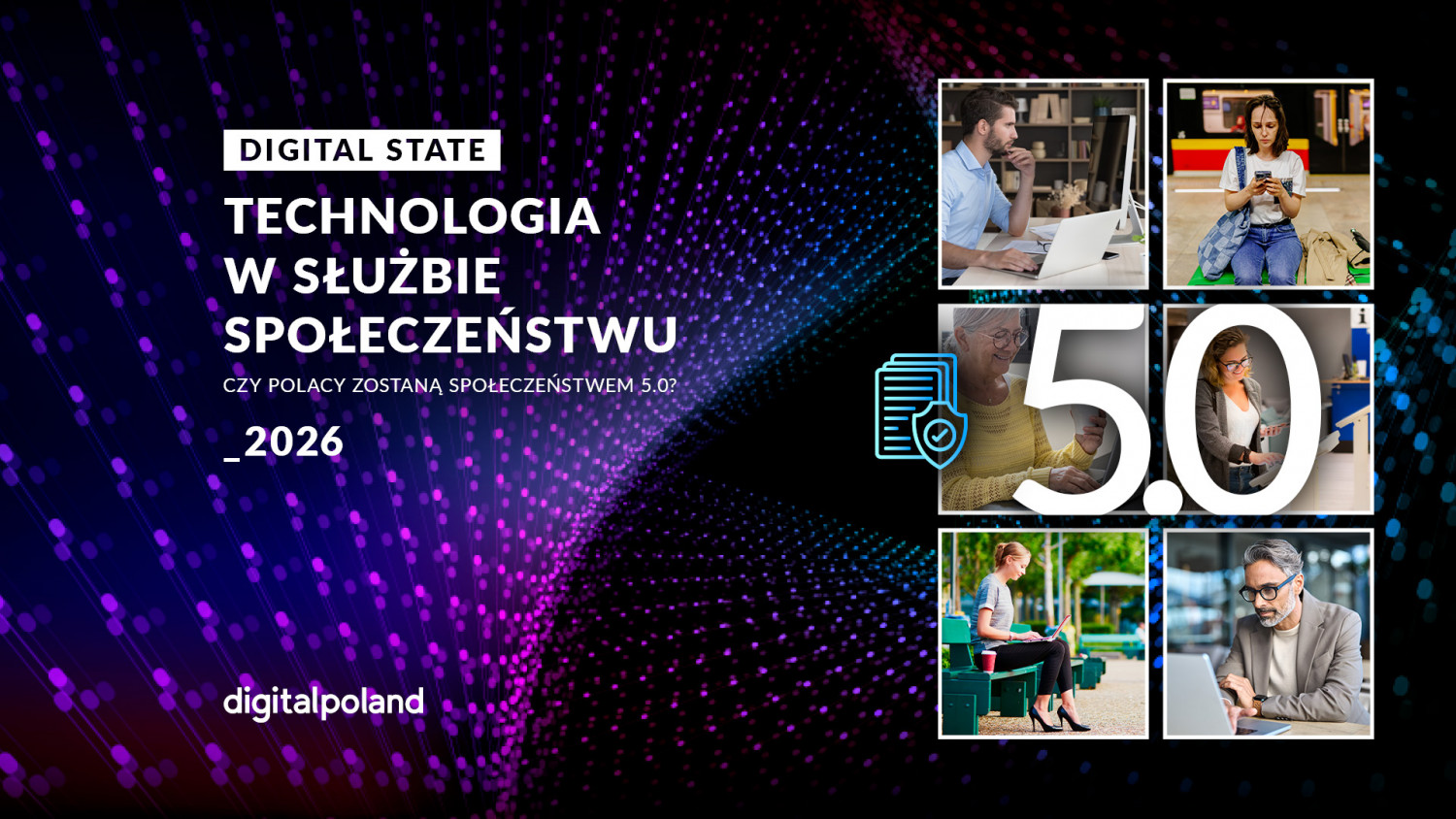
Over the past year, 83 per cent of Poles aged between 18 and 75 have used digital public administration services, and nearly 8 in 10 of these users rate their development highly. At the same time, only 9 per cent of respondents would accept a model in which artificial intelligence makes decisions independently on official matters. These are among the key findings of the eighth edition of the Tech4Society report, prepared by the Digital Poland Foundation in collaboration with Bank Gospodarstwa Krajowego and NielsenIQ. The report was launched on 5 October 2026 during the Digital Festival.
This year’s edition of the survey focuses on the digitalisation of public administration services. Experts and the Foundation’s partners examined how Poles assess e -government, where they see a role for artificial intelligence in government offices, whether they are prepared to do away with paper documents, and what they expect from the mObywatel app and the European Digital Identity Wallet, which is set to launch on Christmas Eve 2026.
Dealing with official matters online is no longer the preserve of the most tech-savvy users. The vast majority of the population uses the government’s e-services, although differences relating to education and place of residence are still evident. 95 per cent of people with higher education and 73 per cent of people with primary or vocational education have used digital public services. In the largest towns and cities, the proportion of users stands at 89 per cent, and in the smallest at 80 per cent.
Poles not only use e-government services but also view their development positively. 6 out of 10 respondents believe that digitalisation has simplified and speeded up the process of dealing with official matters. At the same time, one in five respondents recognises that some online services still replicate paper-based procedures, requiring the same information to be provided repeatedly.
The survey also challenges the belief that a large proportion of the population remains excluded from digital public services due to a lack of devices or the necessary skills. Only 2.46 per cent of all respondents cite a lack of digital skills as the reason for not using e-services, whilst a lack of access to equipment or the internet is cited by just 0.77 per cent. The next challenge, therefore, is not the launch of new services per se, but above all simplifying them and tailoring them to citizens’ needs.
“Poles no longer wonder whether the state should be digital, as it has become part of their everyday lives. Today, the key challenge is, above all, building trust in the digital state”
Anna Węgrzynowicz, social responsibility expert at Bank Gospodarstwa Krajowego
Poles are open to the use of artificial intelligence in public administration, but they draw a clear line between support and the complete takeover of the decision-making process.
Although 43 per cent of respondents view the general possibility of AI automatically processing cases positively, once specific operational models are presented, only 9 per cent opt for full automation. By far the most popular approach is one in which artificial intelligence analyses a case, identifies the relevant regulations or prepares a proposed decision, but the final ruling remains in the hands of a civil servant. As many as 69 per cent of Poles opt for this model.
Acceptance of the use of AI in public administration also depends on the importance of the matter. Around 4 in 10 respondents would agree to the system filling in forms, providing information, analysing documents or identifying available benefits. However, only 13 per cent would entrust it with issuing complex legal or tax decisions. Poles are most concerned about a wrong decision that would be difficult to appeal against. The risks of system failure, cyber-attacks and loss of privacy also remain significant. The digitisation of public administration must therefore include a clear justification for decisions, an effective appeals process and the identification of the person responsible for resolving the matter.
Less than half of Poles – 48 per cent – are currently prepared to deal with the administration exclusively electronically. The main barriers, however, do not stem from a lack of access to technology. Respondents cite, above all, the need for human contact, the risk of system failures and cyberattacks, and the belief that paper documents provide greater legal certainty.
Attitudes towards digital documents depend on the type and importance of the matter. 76 per cent of respondents accept electronic forms for prescriptions, referrals and sick notes, whilst 66 per cent do so for tax returns. Paper documents, however, remain the preferred option for property matters, notarial deeds, diplomas and civil status documents.
As many as 67 per cent of Poles believe that a public administration based solely on digital documents could become paralysed in the event of a major system failure or cyber-attack. The results argue in favour of the state developing in line with the digital first principle, where the internet becomes the primary channel of contact, but not the unconditional digital only approach, which excludes other forms of service delivery.
“Despite many achievements, in a sense we are only halfway there. Poles appreciate digital public administration services, but they still need a sense of control, the opportunity to interact with a human being, and the assurance that technology will not restrict their rights”
dr Michał Boni, President of the Digital Poland Foundation, former Minister for Digital Affairs and Administration
Over the past year, 7 out of 10 Poles aged between 18 and 75 have used the mObywatel app. The app is trusted by 58 per cent of all respondents, but among its users, the level of trust rises to 72 per cent.
mObywatel has not yet completely replaced the traditional wallet, as less than half – 46 per cent of users – regard it as a full substitute for physical documents and no longer carry their plastic equivalents with them. For 52 per cent, however, it remains a convenient addition to traditional documents.
Poles also want greater transparency regarding the use of their data. 61 per cent of respondents support the introduction of a feature in mObywatel allowing them to check which authority, official or IT system has accessed their data and for what purpose. One in three Poles considers such a feature essential.
“A digital state should be transparent and trustworthy for its citizens. That is why everyone should know who has accessed their data, when and on what grounds”
Bartłomiej Pejo, Member of the Sejm, Chair of the Committee on Digitalisation, Innovation and New Technologies
Three out of four Poles intend to use the European Digital Identity Wallet, or EUDI. The largest group, 36 per cent, would choose only a solution offered by the state, such as an enhanced version of mObywatel. A further 33 per cent would like to have the option to choose between a state-run wallet and private solutions. Only 7 per cent of respondents would choose only a wallet offered by a global technology company, so-called ‘big tech’ such as Google Wallet, Apple Wallet or Samsung Wallet. In total, 47 per cent of Poles would place the most trust in a Polish or European provider. This result shows that the choice of a digital identity provider is not merely a matter of convenience for the public, but also one of trust and digital sovereignty.
The practical functions of the digital wallet are of the greatest interest. Poles would like to use EUDI for international financial services and payments, accessing healthcare and dealing with official matters abroad. Over half also view positively the possibility of verifying selected attributes, such as being of legal age, without disclosing full personal details.
The findings of the eighth edition of the report show that Poles no longer question whether the state should be digital. It must be digital, but they want to know how it will protect their data, ensure the continuity of services and guarantee the possibility of appealing against an erroneous decision made by an algorithm or an official – even one who is increasingly virtual.
The public mandate and consent for further digitalisation are clear, but conditional. Poles believe that artificial intelligence can speed up the processing of matters, but should not replace the accountability of a civil servant. Digital channels may become the norm, but should not be the only option available. The development of mObywatel and the European Digital Wallet, on the other hand, should give citizens greater control over their data and the way their identity is verified.
The report ‘Technology in the Service of Society. Will Poles Become a Society 5.0? 2026 Edition’ was produced in collaboration with the Digital Poland Foundation, Bank Gospodarstwa Krajowego and NielsenIQ. It was launched during the eighth edition of the Digital Festival, the largest private educational and technological initiative in Poland. The campaign takes place every year from 1 October to 10 November – a truly digital date. This year’s slogan is ‘You can do more with a digital identity’, which ties in with the launch of EUDI in 2026.
The Digital Festival is held under the honorary patronage of the Conference of Rectors of Academic Schools in Poland, the Ministry of Digital Affairs, the Ministry of National Education, the Ministry of Science and Higher Education, the National Centre for Research and Development, and the Łukasiewicz Research Network. The event is also held under the patronage of, amongst others, the National Chamber of Electronic Economy and Telecommunications.
Strategic partners: Ringier Axel Springer Polska, TVN Warner Bros. Discovery.
Partners: Bank Gospodarstwa Krajowego, EY, NielsenIQ.
The report can be downloaded free of charge from the Digital Poland Foundation’s website following registration.